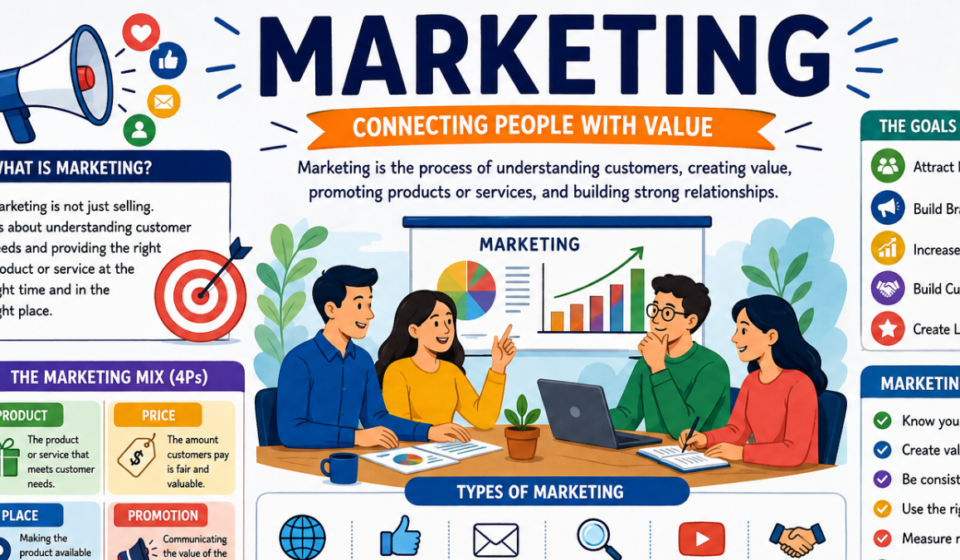

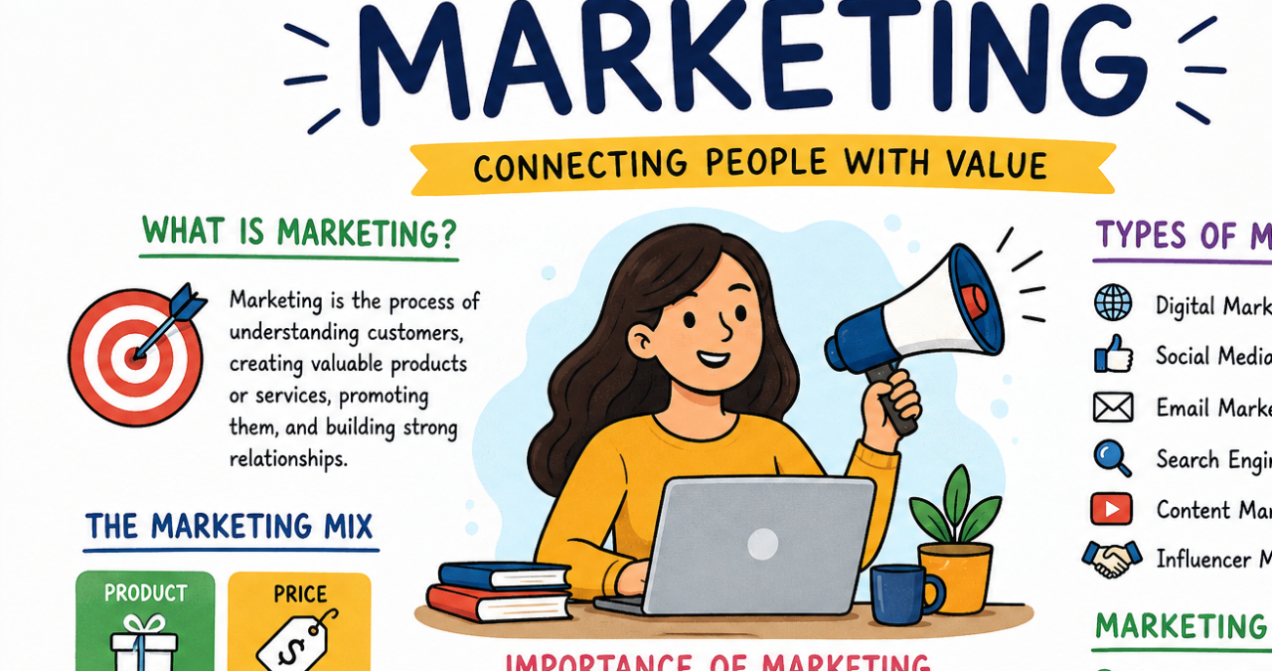
Marketing is one of the most important parts of modern business. Marketing is the process of understanding customers, creating useful products or services, telling people about them, and building strong relationships with buyers. Whether a company sells clothing, food, software, cars, books, or professional services, marketing helps connect that business with the people who need or want what it offers.
In simple words, marketing is about getting the right message to the right people at the right time. It isn’t only about selling something. Good marketing helps a business understand what customers need and how it can provide value. When done properly, marketing can create trust, improve customer satisfaction, increase sales, and help a company grow for many years.
Today, marketing can happen in many places. A business may use television, newspapers, websites, social media, email, search engines, videos, events, or even word-of-mouth recommendations. Because technology continues to change, marketers must stay curious, flexible, and ready to learn.
What Is Marketing?
Marketing is a broad business activity that includes research, planning, promotion, communication, sales support, and customer relationship building. Its main purpose is to create value for customers while helping a business achieve its goals.
Imagine that a company creates a new school backpack. Making the backpack is only one part of the business. The company must also learn what students and parents want, decide on a suitable price, choose where to sell the backpack, create useful advertisements, and explain why the product is different from other bags. All these activities are connected to marketing.
Marketing starts before a product reaches the customer and continues after a purchase. Businesses study customer feedback, answer questions, improve products, and try to keep customers happy.
This means marketing is not simply saying, “Buy our product.” Instead, effective marketing asks important questions such as:
- Who needs this product?
- What problem does it solve?
- What do customers care about?
- How much are customers willing to pay?
- Where do potential customers look for information?
- Why should someone choose this product instead of another one?
- How can the business earn and keep customer trust?
When businesses answer these questions carefully, their marketing efforts become much stronger.
Why Marketing Matters to Businesses
Almost every successful business needs marketing. Even an excellent product can struggle if people don’t know that it exists. Marketing helps businesses become visible and communicate their value.
A small local bakery, for example, may have wonderful cakes but only a few customers. By using signs, social media posts, local events, customer recommendations, and attractive product displays, the bakery can reach more people.
Large companies also depend heavily on marketing. They may have teams that study customers, create advertisements, manage websites, produce videos, plan campaigns, and measure results.
Marketing can help a business:
- Attract new customers
- Build brand awareness
- Increase sales
- Introduce new products
- Understand customer needs
- Develop customer loyalty
- Stand out from competitors
- Build a positive reputation
- Communicate important information
- Enter new markets
In the long run, strong marketing can become a major competitive advantage.
The Main Goals of Marketing
Different businesses may have different marketing goals. A new company may want people to recognize its name, while an established company may want to increase customer loyalty.
One common goal is awareness. Customers need to know that a business or product exists before they can consider buying it.
Another goal is customer engagement. Businesses want people to interact with their content, ask questions, visit their websites, attend events, or follow their social media accounts.
A further goal is conversion. This means encouraging a potential customer to take a desired action, such as making a purchase, signing up for a service, or requesting more information.
Marketing may also focus on customer retention. Keeping an existing customer can be very valuable because satisfied customers may return and recommend the business to others.
The major goals often include:
- Creating awareness
- Generating interest
- Building trust
- Encouraging purchases
- Improving customer experience
- Increasing loyalty
- Supporting long-term growth
A smart marketing plan usually combines several of these goals rather than focusing on only one.
Understanding the Marketing Mix
One of the classic ideas in marketing is the marketing mix. It helps businesses think about the important decisions involved in selling a product or service.
The traditional marketing mix is often explained through four major areas: product, price, place, and promotion.
| Marketing Element | Meaning | Example |
|---|---|---|
| Product | What the business offers | A comfortable school backpack |
| Price | What customers pay | An affordable selling price |
| Place | Where the product is available | Shops and online stores |
| Promotion | How customers hear about it | Social media and advertisements |
Product
The product must solve a problem or provide something customers value. Businesses should consider quality, design, features, packaging, safety, and usefulness.
A product doesn’t always have to be completely new. Sometimes improving an existing product can create strong customer interest.
Price
Price affects how customers view a product. A very high price may make a product seem premium, while a low price may attract budget-conscious buyers.
Businesses must consider production costs, competition, customer expectations, and the value provided when setting prices.
Place
Place refers to where and how customers can obtain a product. Some products are sold through physical stores, while others are mainly available online.
The goal is to make purchasing convenient for the target customer.
Promotion
Promotion involves communicating with potential customers. It can include advertising, public relations, social media, email, events, videos, special offers, and other methods.
Good promotion explains benefits clearly instead of simply making loud claims.
Traditional Marketing
Traditional marketing refers to methods that were widely used before digital platforms became central to business communication. These methods remain useful for many companies.
Examples include:
- Television advertisements
- Radio advertisements
- Newspapers
- Magazines
- Billboards
- Flyers
- Posters
- Direct mail
- Public events
- Printed brochures
Traditional methods can be especially useful for reaching local communities or broad audiences.
For example, a restaurant opening in a neighborhood might use posters, local newspapers, signs, and community events to attract attention. A radio advertisement can also reach people while they are driving or working.
The key is not to assume that older methods are useless. The best approach depends on the audience, product, budget, and goals.
Digital Marketing
Digital marketing has changed the way businesses communicate with customers. It uses internet-based channels to share information, build relationships, and encourage action.
Some major forms include:
- Search engine marketing
- Social media marketing
- Email marketing
- Content marketing
- Video marketing
- Website marketing
- Influencer marketing
- Online advertising
Digital marketing offers an important advantage: businesses can often measure how people interact with their campaigns.
For example, a company can examine website visits, advertisement clicks, email opens, video views, and other useful information. These measurements can help marketers understand what is working and what needs improvement.
However, digital marketing isn’t automatically successful. A business still needs a useful product, clear communication, good customer service, and a strong understanding of its audience.
Social Media Marketing
Social media has become a major part of modern marketing. Platforms allow businesses to communicate with customers in a more direct and regular way.
A company may share:
- Product demonstrations
- Educational posts
- Short videos
- Customer stories
- Behind-the-scenes content
- Company news
- Helpful tips
- Answers to common questions
Social media can also make a business feel more human. Customers can comment, ask questions, and share their experiences.
But businesses must use social media responsibly. Posting too frequently, making false claims, ignoring complaints, or copying competitors can damage trust.
The best social media content usually provides something useful, interesting, entertaining, or meaningful.
Content Marketing
Content marketing focuses on creating and sharing useful information instead of constantly asking people to buy something.
For example, a company that sells gardening equipment could publish articles about caring for plants. A company that sells computers could create simple guides explaining how to protect files and improve device performance.
Content may include:
- Blog articles
- Guides
- Videos
- Infographics
- Tutorials
- Podcasts
- Frequently asked questions
- Educational posts
Helpful content can build authority and trust. When customers repeatedly receive useful information from a company, they may begin to see that company as a reliable source.
That’s where the magic happens: the business provides value first, and trust grows over time.
Search Engine Marketing and SEO
Search engines are an important source of information for customers. People often search online when they want to solve a problem, compare products, or find a service.
Search engine optimization, commonly called SEO, helps websites become easier for search engines and users to understand.
Good SEO can involve:
- Creating useful content
- Using relevant search terms naturally
- Writing clear headings
- Improving website speed
- Making pages easy to navigate
- Providing accurate information
- Building trustworthy website signals
- Making content useful for visitors
SEO should not be treated as a trick for manipulating search results. The strongest approach is to create content that genuinely helps readers.
When a website answers a customer’s question clearly, it has a better chance of attracting meaningful visitors.
Email Marketing
Email marketing allows businesses to communicate directly with people who have chosen to receive messages.
Companies may use email to share:
- New product announcements
- Special offers
- Educational information
- Company updates
- Helpful recommendations
- Event invitations
- Customer reminders
Good email marketing respects the reader’s time. Messages should be clear, useful, and easy to understand.
A strong email usually has a meaningful subject, a simple message, and a clear action. Businesses should also follow applicable privacy and communication rules.
Sending too many unwanted emails can quickly frustrate customers. Quality matters more than quantity.
Understanding the Target Audience
One of the most important parts of marketing is understanding the target audience.
A target audience is the group of people a business hopes to serve. These people may share certain needs, interests, behaviors, or purchasing situations.
For example, a company selling educational software might focus on students, parents, schools, or teachers. Each group may have different concerns.
Businesses can study:
- Age groups
- Buying habits
- Interests
- Common problems
- Location
- Budget
- Product preferences
- Online behavior
Understanding the audience helps marketers create messages that feel relevant rather than random.
Instead of saying, “Our product is great,” a company can explain how the product solves a specific problem for a specific group of people.
The Customer Journey
Customers usually don’t go directly from discovering a product to buying it. Their decision may involve several stages.
The customer journey can be viewed as a path:
Awareness → Interest → Consideration → Purchase → Experience → Loyalty
During the awareness stage, people first learn about a business.
During the interest stage, they begin looking for more information.
During consideration, they compare choices and think about price, quality, reviews, and features.
At the purchase stage, they decide whether to buy.
After the purchase, their experience becomes important. If the product works well and customer service is helpful, the customer may return.
Eventually, satisfied customers may become loyal supporters who recommend the brand to friends and family.
Brand Building Through Marketing
A brand is more than a logo or a business name. It represents the overall impression people have about a company.
Brand building can involve:
- Visual identity
- Brand voice
- Customer service
- Product quality
- Company values
- Advertising
- Website experience
- Packaging
- Public reputation
Consistency matters. If a company presents itself as friendly but provides poor customer service, customers may become confused or disappointed.
A trustworthy brand tries to match its promises with real customer experiences.
Over time, this consistency can make a business easier to recognize and remember.
The Role of Customer Trust
Trust is one of the foundations of successful marketing. Customers want to feel confident that a business will deliver what it promises.
Businesses can build trust by:
- Providing accurate information
- Avoiding misleading claims
- Protecting customer information
- Responding honestly to problems
- Showing clear prices
- Providing dependable products
- Admitting mistakes when necessary
- Listening to customer feedback
Trust cannot be built overnight. It grows through repeated positive experiences.
A business that tries to gain quick sales through dishonest advertising may lose customers in the long term. On the other hand, honest marketing can create relationships that last.
Marketing Research
Marketing decisions should be based on information whenever possible. Marketing research helps businesses learn about customers, competitors, markets, and trends.
Research methods may include:
- Customer surveys
- Interviews
- Online research
- Product reviews
- Competitor analysis
- Website data
- Sales information
- Customer service feedback
Suppose a company notices that customers frequently complain about complicated packaging. That feedback can become an opportunity for improvement.
Research doesn’t always require a huge budget. Even a small business can ask customers simple questions and carefully observe what people need.
Measuring Marketing Success
A marketing campaign should have a way to measure performance. Without measurement, a business may spend money without knowing whether its efforts are helping.
Useful measurements can include:
- Website traffic
- Sales
- Customer inquiries
- Social media engagement
- Email responses
- New customers
- Repeat purchases
- Leads
- Conversion rates
- Customer satisfaction
Different goals require different measurements.
For example, a campaign designed to increase awareness may focus on reach and engagement. A sales campaign may focus more heavily on purchases and revenue.
The important point is to measure results that connect with the original goal.
Common Marketing Mistakes
Even experienced businesses can make marketing mistakes. Recognizing these problems can help companies avoid unnecessary costs.
Trying to Reach Everyone
A message designed for everyone may connect strongly with almost no one. A clear target audience often produces better communication.
Making False Promises
Exaggerated claims can attract attention temporarily but may destroy trust later.
Ignoring Customers
Customers provide valuable information. Ignoring their questions and complaints can create a poor reputation.
Copying Competitors
A business should understand competitors but develop its own useful identity.
Focusing Only on Sales
Marketing should provide value and build relationships, not simply push customers toward purchases.
Forgetting the Customer Experience
A beautiful advertisement cannot fix a poor product or bad service. The entire customer experience matters.
Ethical Marketing
Ethical marketing means communicating honestly and treating customers fairly. It is an important part of responsible business.
Ethical marketers avoid deceptive practices and respect customer privacy.
Responsible marketing should:
- Use truthful information
- Clearly explain important conditions
- Respect customer choices
- Avoid unfair manipulation
- Protect personal information
- Treat customers with respect
- Correct inaccurate information
Ethical behavior isn’t only about following rules. It can also strengthen a company’s reputation.
The Future of Marketing
Marketing will continue to change as technology and customer behavior develop. Artificial intelligence, automation, data analysis, personalized experiences, video, voice technology, and new digital platforms are likely to influence future strategies.
However, some principles won’t change.
Customers will still want:
- Useful products
- Fair prices
- Honest information
- Convenient experiences
- Helpful service
- Respect
- Trust
Technology may change the tools marketers use, but human needs remain at the center.
Successful marketers will need both technical skills and human understanding. They must know how to use modern tools while remembering that every customer is a real person with questions, expectations, and feelings.
Useful Skills for a Marketing Career
Marketing can offer many career opportunities. People interested in this field can develop a wide range of skills.
Important skills include:
- Communication
- Writing
- Creativity
- Research
- Problem-solving
- Data analysis
- Teamwork
- Planning
- Presentation
- Customer understanding
- Basic technology skills
A person doesn’t have to be an expert in every area. Some marketers specialize in content, advertising, SEO, social media, research, branding, or analytics.
Curiosity is especially valuable. Marketing changes often, so professionals need to keep learning.
Marketing for Small Businesses
Small businesses may not have the large budgets of major companies, but they can still use effective marketing.
A local business can start with simple actions such as:
- Creating a clear website
- Maintaining accurate business information
- Asking satisfied customers for reviews
- Posting useful social media content
- Building relationships with local communities
- Offering helpful customer service
- Learning what nearby customers need
- Creating valuable educational content
Small businesses can also benefit from personal relationships. A friendly conversation with a customer can sometimes be more powerful than an expensive advertisement.
The key is to focus resources carefully and choose methods that match the business and audience.
How to Create a Strong Marketing Plan
A marketing plan gives a business a clear direction. Without a plan, activities can become scattered and difficult to measure.
A simple marketing plan can include these steps:
Understand the customer: Identify who the business wants to reach.
Define the goal: Decide what the campaign should achieve.
Study the market: Learn about customer needs and competitors.
Create the message: Explain the product’s value clearly.
Choose the channels: Select platforms where the target audience spends time.
Set a budget: Decide how much the business can reasonably invest.
Launch the campaign: Put the plan into action.
Measure results: Study what happened.
Improve the strategy: Keep what works and change what doesn’t.
This process turns marketing from guesswork into a more organized business activity.
Marketing and Customer Relationships
Modern marketing is increasingly focused on relationships rather than one-time transactions.
A customer who buys something once is valuable, but a customer who returns repeatedly can become even more important. Loyal customers may also recommend the business to others.
Relationship marketing can include:
- Personalized communication
- Loyalty programs
- Helpful customer service
- Follow-up messages
- Customer education
- Feedback requests
- Exclusive experiences
The goal is to make customers feel respected and valued.
After all, people remember how a business treated them, not just what it sold.
Marketing in Everyday Life
Marketing isn’t limited to large corporations. We see it every day.
When a restaurant places an attractive menu outside, that’s marketing. When a local shop posts a new product online, that’s marketing. When a friend recommends a useful service, that can influence buying decisions too.
Even packaging can communicate a message. Colors, words, images, design, and product placement can influence how people perceive an item.
Understanding marketing can therefore help consumers become smarter shoppers. When people understand how advertisements work, they can think carefully about claims instead of accepting every message immediately.
Final Thoughts on Marketing
Marketing is a powerful combination of communication, research, creativity, planning, and customer understanding. It helps businesses explain their value and connect with the people they hope to serve.
The strongest marketing isn’t simply about making noise. It’s about being useful, honest, relevant, and consistent. A successful company listens to customers, understands their needs, creates valuable solutions, and communicates clearly.
From traditional advertisements to modern digital platforms, marketing continues to evolve. Yet its basic purpose remains simple: connect people with products, services, ideas, and experiences that can provide value.
For businesses, students, entrepreneurs, and future professionals, learning the basics of marketing can open the door to many opportunities. With careful research, ethical communication, creativity, and a willingness to learn, almost any organization can improve the way it reaches and serves its audience.
In a competitive world, businesses that understand people and communicate with honesty have a strong foundation for growth. That is why marketing remains an essential part of successful business and will continue to matter in the future.