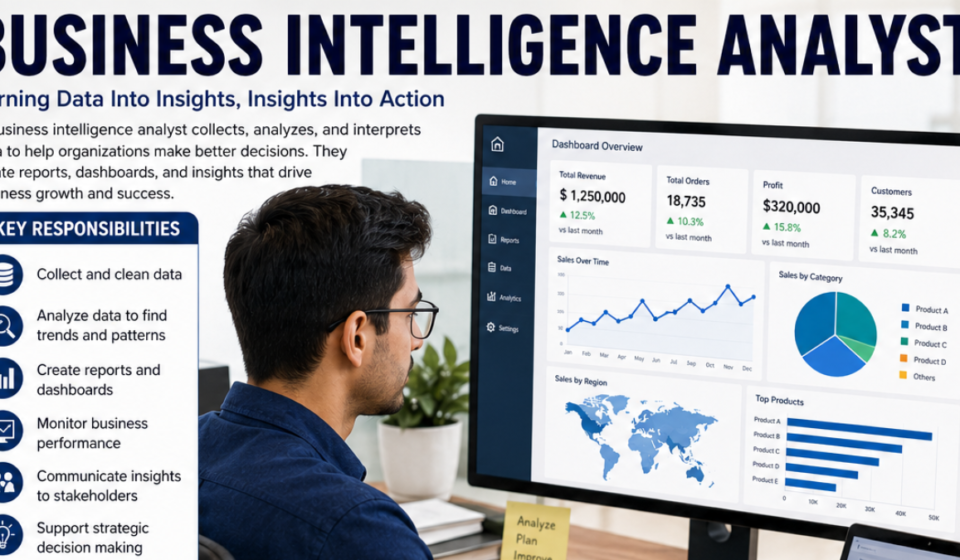

A business intelligence analyst plays an important role in helping modern companies understand their data and make better decisions. Businesses collect information from many sources, including sales systems, websites, customer accounts, financial records, marketing campaigns, and employee activities. However, raw data alone isn’t very useful unless someone can understand it and turn it into meaningful information.
This is where a business intelligence analyst becomes valuable. These professionals study business data, identify patterns, create reports, build dashboards, and provide useful insights to managers and decision-makers. In simple words, they help businesses answer important questions such as what is working, what isn’t working, why sales are changing, and where the company can improve.
As companies continue to depend on technology and data, the role of a business intelligence analyst has become increasingly important. Whether it is a small company, a growing online store, a bank, a hospital, or a large international organization, good decisions often begin with good information.
What Is a business intelligence analyst?
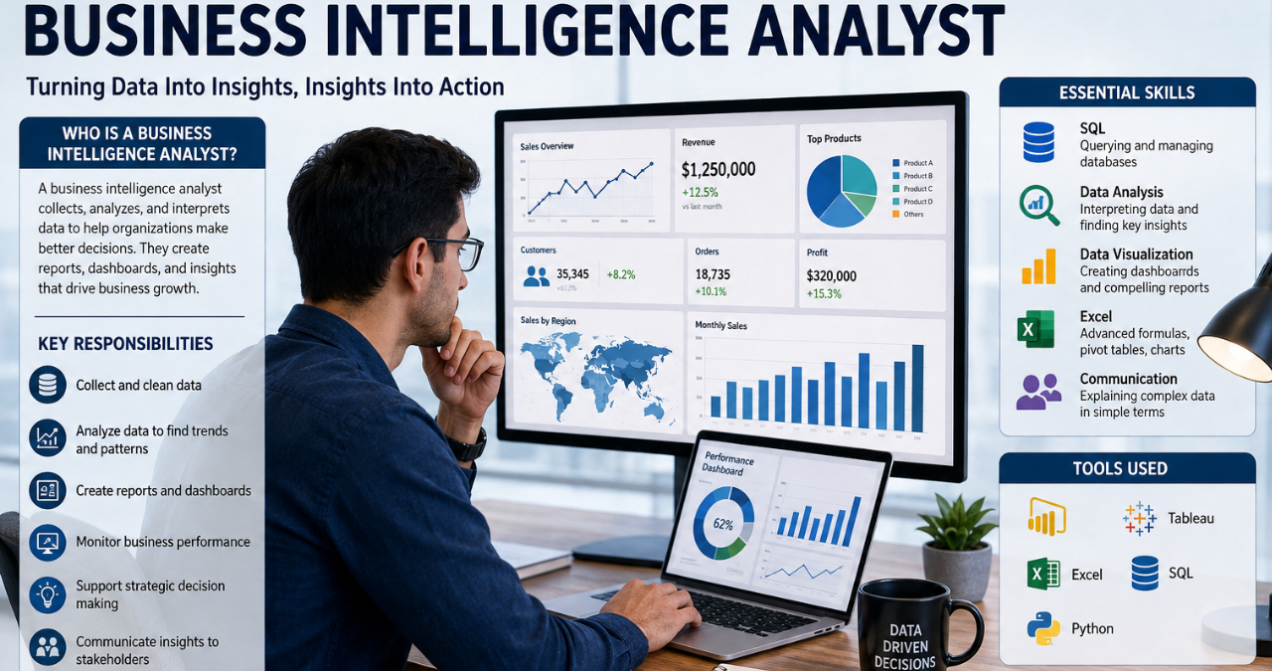
A business intelligence analyst is a professional who collects, studies, and explains business data. Their main goal is to help an organization make informed decisions. Instead of relying only on guesses or personal opinions, businesses can use the findings prepared by an analyst to understand what the numbers are saying.
For example, imagine that an online clothing company notices that its sales have dropped. A manager may know that sales are lower, but they may not know why. A business intelligence analyst can examine sales records, customer behavior, product performance, website traffic, and other information to discover possible reasons.
The analyst may find that a popular product is no longer being promoted, customers are leaving the website before completing purchases, or sales have fallen in a particular region. This information gives management a clearer picture of the situation and helps them choose a practical solution.
Why a business intelligence analyst Matters to Modern Companies
Data has become one of the most valuable resources for businesses. Companies can collect huge amounts of information every day, but having data isn’t the same as understanding it. Without proper analysis, useful information can easily get lost in spreadsheets, databases, and software systems.
A business intelligence analyst helps turn complicated information into something people can understand and use. They connect business goals with data and help different departments see the bigger picture.
Their work can help a company:
- Understand customer behavior
- Monitor sales performance
- Identify business trends
- Track important goals
- Find areas where money is being wasted
- Improve marketing campaigns
- Measure employee or department performance
- Discover opportunities for growth
- Support financial planning
- Improve customer experiences
- Reduce business risks
- Make faster and more informed decisions
In short, a business intelligence analyst helps turn information into action. That’s a big deal in a competitive business environment.
What Does a business intelligence analyst Do?
The daily work of a business intelligence analyst can vary depending on the company, industry, and job level. Some analysts spend more time working with databases, while others focus heavily on dashboards, reports, and communication.
One important responsibility is collecting data from different sources. The analyst may work with sales platforms, customer relationship systems, financial software, websites, surveys, or other business applications.
The data may then need to be cleaned. Data cleaning means finding and correcting problems such as missing values, duplicate records, incorrect entries, or inconsistent information.
After that, the analyst studies the data to discover useful patterns.
Common responsibilities include:
- Gathering business data
- Cleaning and organizing information
- Checking data quality
- Creating reports
- Designing dashboards
- Studying business trends
- Comparing current and previous results
- Finding unusual changes in performance
- Working with managers and other teams
- Explaining findings in simple language
- Supporting strategic planning
- Making recommendations based on evidence
A good analyst doesn’t simply say, “Sales went down.” They try to answer the more useful question: “Why did sales go down, and what can the company do about it?”
Skills Needed to Become a business intelligence analyst
Becoming a successful business intelligence analyst requires a mixture of technical, business, and communication skills. You don’t need to know everything on day one. Like any professional career, these skills can be developed through study, practice, and real-world experience.
Data Analysis Skills
Data analysis is at the heart of the profession. Analysts need to understand how to organize information, compare values, recognize patterns, and identify meaningful changes.
They should be comfortable working with tables, charts, percentages, averages, trends, and other forms of business information.
SQL Knowledge
SQL is widely used for working with databases. A business intelligence analyst often uses SQL to retrieve specific information from large collections of business data.
Learning SQL can help an analyst answer questions such as:
- Which products sold the most?
- Which customers made repeat purchases?
- Which regions generated the most revenue?
- How did sales change over time?
Strong SQL skills can make data work much easier and more efficient.
Spreadsheet Skills
Spreadsheets remain useful in many businesses. Tools such as Microsoft Excel and similar spreadsheet applications can help analysts organize information, calculate results, and create simple reports.
Important spreadsheet skills may include:
- Formulas
- Sorting and filtering
- Pivot tables
- Charts
- Conditional formatting
- Data organization
- Basic statistical calculations
Data Visualization
Numbers can sometimes be difficult to understand when they are presented in large tables. Data visualization makes information easier to interpret.
A business intelligence analyst may use charts, graphs, maps, and dashboards to communicate findings.
Popular business intelligence and visualization platforms include tools such as Power BI, Tableau, and similar systems.
Communication Skills
Technical knowledge isn’t enough. An analyst must also explain results clearly.
A manager may not want to hear a complicated technical explanation about database queries. They want to know what the information means for the business.
A strong analyst can take complicated findings and explain them in simple language.
Business Knowledge Is Just as Important
The word “business” in business intelligence analyst matters. An analyst isn’t only working with numbers. They are using information to solve business problems.
For example, an analyst working for a supermarket might study product sales, customer visits, seasonal trends, and pricing. An analyst working for a bank may focus on customer accounts, transactions, financial performance, and risk.
Understanding the industry helps the analyst ask better questions.
Useful business knowledge can include:
- Sales
- Marketing
- Finance
- Customer service
- Operations
- Supply chains
- Product management
- Business strategy
The stronger the understanding of the business, the easier it becomes to recognize which findings actually matter.
Tools Commonly Used by a business intelligence analyst
Technology is an important part of business intelligence work. Different organizations use different software, but several categories of tools are common.
| Tool or Skill | Main Purpose |
|---|---|
| SQL | Working with databases |
| Excel | Organizing and analyzing data |
| Power BI | Building dashboards and reports |
| Tableau | Data visualization |
| Python | Data analysis and automation |
| Databases | Storing business information |
| Cloud platforms | Managing modern data systems |
| Presentation tools | Explaining findings |
A beginner doesn’t have to master every tool at once. It’s usually better to learn the basics of one tool, practice with real examples, and gradually expand the skill set.
How a business intelligence analyst Uses Data
The process usually begins with a business question.
For example, a company may ask:
“Why are customers buying fewer products this month?”
The business intelligence analyst first identifies what information is needed to investigate the question. They may collect sales data, customer information, product details, website activity, and marketing results.
Next, the analyst checks and cleans the data. Once the information is reliable, they analyze it and search for patterns.
Suppose the analysis shows that customers are visiting the website at the same rate as before, but fewer people are completing purchases. The analyst might then study product prices, checkout performance, delivery charges, payment problems, and customer feedback.
The final result could be presented through a dashboard or report.
This process can be summarized as:
Business question → Data collection → Data cleaning → Analysis → Visualization → Insight → Business decision
That’s the real value of business intelligence: connecting data with practical decisions.
Difference Between a business intelligence analyst and a Data Analyst
The two roles can look very similar, and there is often some overlap. However, their focus can be different depending on the organization.
A data analyst may work on a broad range of analytical questions and datasets. A business intelligence analyst often focuses more directly on business performance, reporting, dashboards, trends, and decision support.
| Area | business intelligence analyst | Data Analyst |
| Main focus | Business decisions and performance | Data investigation and insights |
| Common work | Dashboards, reports, trends | Analysis, research, reporting |
| Business involvement | Usually high | Can vary |
| Visualization | Very important | Important |
| SQL | Commonly used | Commonly used |
| Communication | Important | Important |
| Strategic support | Often a major responsibility | Depends on the role |
There is no universal rule separating these jobs. Companies may use the titles differently, so job descriptions should always be read carefully.
Education and Qualifications
There are several ways to prepare for a career as a business intelligence analyst.
Many professionals study subjects related to:
- Business administration
- Information systems
- Computer science
- Statistics
- Economics
- Finance
- Data analytics
- Mathematics
A formal degree can be useful, but practical skills matter greatly too. Online courses, personal projects, certifications, internships, and hands-on practice can help build a strong portfolio.
A beginner can start with basic spreadsheet skills and gradually move toward SQL, data visualization, databases, and advanced analytics.
The key is consistency. You don’t have to climb the entire mountain in one day.
Building Practical Experience
Experience is one of the best ways to develop confidence.
Students and beginners can create small projects using publicly available datasets. For example, they might study:
- Retail sales
- Movie ratings
- Website traffic
- Customer purchases
- Sports statistics
- Public transportation
- Weather information
- Business expenses
A project could include a dataset, a few business questions, charts, a dashboard, and a written explanation of the findings.
This kind of work can demonstrate that a person understands more than just software. It shows that they can use information to answer meaningful questions.
A portfolio can become especially useful when applying for entry-level jobs.
Important Qualities of a Successful business intelligence analyst
Technical skills are only one piece of the puzzle. Great analysts also have strong personal and professional qualities.
Curiosity
Good analysts ask questions. When they see an unusual change, they don’t simply ignore it.
They wonder:
“Why did this happen?”
“What changed?”
“Can we verify the reason?”
“What does this mean for the company?”
Attention to Detail
Small errors can create misleading results. Analysts need to check their work carefully.
Problem-Solving
Business problems aren’t always simple. Analysts must break large problems into smaller questions and investigate them step by step.
Communication
The best analysis is not useful if nobody understands it. Clear communication makes insights more valuable.
Critical Thinking
An analyst should not automatically assume that one event caused another. They need to examine evidence and consider alternative explanations.
Challenges Faced by a business intelligence analyst
Like any career, this profession has challenges.
One common problem is poor data quality. Business systems may contain incomplete or outdated information. Cleaning that data can take time.
Another challenge is having too much information. More data doesn’t automatically mean better decisions. Analysts must identify the information that actually matters.
Communication can also be challenging. Different departments may have different priorities and expectations.
Common challenges include:
- Incomplete data
- Duplicate records
- Conflicting information
- Changing business requirements
- Tight deadlines
- Large datasets
- Difficult technical systems
- Unclear business questions
- Misunderstanding of analytical results
A professional approach helps overcome these problems. Good documentation, careful testing, clear communication, and strong teamwork can make a major difference.
Career Growth for a business intelligence analyst
The career path can develop in several directions. Someone may begin in an entry-level reporting or analytics position and gradually take on more complex responsibilities.
With experience, professionals may move toward positions such as:
- Senior Business Intelligence Analyst
- Business Intelligence Developer
- Data Analyst
- Analytics Consultant
- Business Intelligence Manager
- Data Visualization Specialist
- Analytics Manager
- Data or Business Intelligence Architect
Some professionals also move into broader business strategy or management roles.
The career can be especially rewarding for people who enjoy both technology and business.
Industries That Hire Business Intelligence Professionals
Almost every major industry can benefit from data analysis.
A business intelligence analyst may work in:
- Banking
- Retail
- Healthcare
- Manufacturing
- Education
- Telecommunications
- Technology
- Transportation
- Logistics
- Hospitality
- Government
- Insurance
- E-commerce
- Entertainment
For example, a retail company may use business intelligence to understand customer purchases. A transportation company may study routes and demand. A hospital may analyze operational information to improve services.
The possibilities are broad because almost every organization produces data.
How Artificial Intelligence Is Changing Business Intelligence
Artificial intelligence is changing the way companies work with information. Modern systems can help automate certain tasks, detect patterns, generate summaries, and make analytical work faster.
However, AI doesn’t remove the need for human judgment.
A business intelligence analyst still needs to understand the business question, check whether the data is reliable, review results, and explain what the findings mean.
AI can be viewed as a powerful assistant rather than a complete replacement for human decision-making.
The future may involve analysts spending less time on repetitive tasks and more time on strategic questions, interpretation, communication, and problem-solving.
Tips for Beginners
If you’re thinking about becoming a business intelligence analyst, start with the basics.
Build Strong Spreadsheet Skills
Learn how to organize, filter, calculate, and visualize information.
Learn SQL
Practice writing simple queries and gradually move toward more advanced database work.
Explore Visualization Tools
Create dashboards using realistic datasets. Focus on making them clear rather than simply making them look attractive.
Study Business Problems
Ask yourself how a company makes money, how it gains customers, and what affects its costs.
Practice Explaining Results
After completing an analysis, explain your findings in a few simple sentences.
Create Projects
Projects provide practical experience and can strengthen a professional portfolio.
Keep Learning
Technology changes quickly. Successful professionals continue improving their skills throughout their careers.
Example of a Real-World Business Intelligence Project
Imagine a food delivery company wants to improve its monthly performance.
The company provides an analyst with information about orders, restaurants, delivery times, customer ratings, locations, and cancellations.
The business intelligence analyst could create a dashboard showing:
- Total orders
- Average delivery time
- Customer ratings
- Cancellation patterns
- Best-performing areas
- Popular restaurants
- Peak ordering periods
The analyst might discover that cancellations increase when delivery times become too long.
Instead of simply reporting the number of cancellations, the analyst can explain the relationship and suggest that management investigate delivery staffing or route planning during busy periods.
This example shows why business intelligence is more than making charts. The real goal is to find useful information that can support better decisions.
Business Intelligence and Better Decision-Making
Businesses face decisions every day. They need to decide what products to promote, where to invest money, which services to improve, and how to respond to changing customer behavior.
Without reliable information, these decisions can become little more than educated guesses.
A business intelligence analyst provides evidence that can make decisions more informed.
This doesn’t mean data will always provide a perfect answer. Business decisions also involve experience, judgment, customer needs, competition, and market conditions.
Still, good data gives decision-makers a stronger foundation.
The Future of the business intelligence analyst Career
The future of business intelligence looks promising because organizations continue to generate and use large amounts of information.
Cloud computing, automation, artificial intelligence, advanced analytics, and improved visualization tools are changing the field. These developments may make it easier for companies to access information and discover insights.
At the same time, human skills will remain important.
Companies still need people who can understand business problems, ask smart questions, check information, communicate clearly, and make thoughtful recommendations.
For future professionals, this means learning technology while also developing business knowledge and communication skills.
Final Thoughts on business intelligence analyst
A career as a business intelligence analyst can be an excellent choice for people who enjoy technology, business, numbers, and problem-solving. The role combines analytical thinking with practical business knowledge, making it both useful and interesting.
A successful analyst doesn’t simply collect data or create attractive dashboards. They look beyond the numbers. They ask meaningful questions, find reliable evidence, identify important patterns, and explain what those findings mean.
The journey can begin with simple skills such as spreadsheets and basic data analysis. From there, learners can develop SQL knowledge, visualization skills, business understanding, and advanced analytical abilities.
As businesses become increasingly data-driven, professionals who can turn complicated information into clear and useful insights will continue to have an important place in the workplace. With patience, curiosity, practice, and a willingness to keep learning, becoming a business intelligence analyst can open the door to a rewarding and future-focused career.