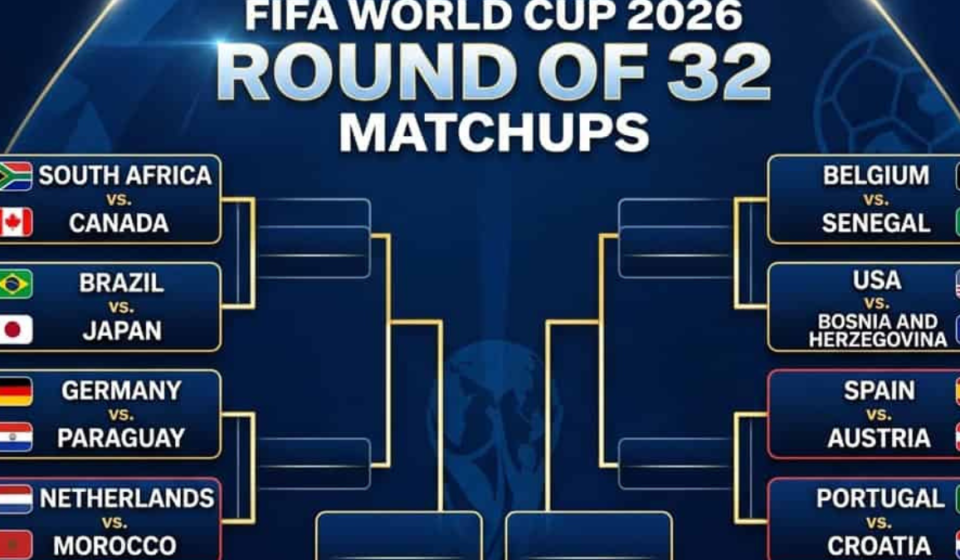

The round of 32 world cup bracket was one of the biggest changes introduced at the 2026 FIFA World Cup. For the first time in tournament history, 48 national teams competed in the World Cup, creating a new knockout round before the traditional Round of 16. FIFA’s expanded format included 12 groups of four teams, with the top two teams from every group and the eight best third-place teams moving into the Round of 32.
The 2026 World Cup was played in Canada, Mexico, and the United States from June 11 to July 19. It featured 104 matches across 16 host cities. The knockout stage began on June 28, and the Round of 32 eventually produced several close games, extra-time dramas, and penalty shootouts.
For readers searching for a clear round of 32 world cup bracket, this guide explains how the bracket worked, how teams qualified, what happened in every Round of 32 match, and how the winners progressed toward the final.
What Is the round of 32 world cup bracket?
The round of 32 world cup bracket is the knockout-stage structure that connects the 32 teams qualifying from the group stage to the Round of 16.
In older World Cup editions, 32 teams began the competition and only 16 moved into the knockout phase. The 2026 tournament was different. With 48 teams participating, FIFA needed an additional knockout round.
The basic structure was:
- 48 teams entered the tournament.
- The teams were divided into 12 groups.
- Each group contained four teams.
- The top two teams from every group advanced.
- Eight of the best third-place teams also advanced.
- That created 32 knockout-stage teams.
- The 32 teams played 16 Round of 32 matches.
- The 16 winners advanced to the Round of 16.
- The knockout stage then continued through the quarter-finals, semi-finals, and final.
FIFA confirmed that the new structure meant a team reaching the final would play eight matches instead of the seven required in the 2022 World Cup.
How the 2026 World Cup Format Created the Bracket
The new format made the group stage especially important. A team didn’t simply need to finish among the top two in a traditional eight-group setup. Instead, teams competed across 12 groups.
The qualification system was straightforward in principle:
| Tournament Stage | Teams/Matches | Main Qualification Rule |
|---|---|---|
| Group Stage | 48 teams | 12 groups of four |
| Round of 32 | 32 teams | Top two from each group + eight best third-place teams |
| Round of 16 | 16 teams | Winners of Round of 32 |
| Quarter-finals | 8 teams | Winners of Round of 16 |
| Semi-finals | 4 teams | Winners of quarter-finals |
| Final | 2 teams | Winners of semi-finals |
This structure created an important difference. Third-place teams still had a path into the knockout rounds, so finishing third wasn’t automatically the end of a team’s tournament.
At the same time, finishing first or second in a group remained highly valuable because it could determine a team’s position in the knockout bracket. FIFA’s official schedule established the matchups based on group positions and qualifying third-place teams.
How Teams Qualified for the Round of 32
Getting into the round of 32 world cup bracket depended on group-stage performance.
Each of the 12 groups had four teams. During the group stage, teams earned points from their matches:
- Three points for a win.
- One point for a draw.
- Zero points for a loss.
The standings then determined which teams advanced.
The top two teams in each group automatically qualified for the Round of 32. That’s 24 teams in total. FIFA then selected the eight best third-place teams to complete the 32-team knockout field.
This system added another layer of excitement. A team could finish third and still have a chance to continue, but its record had to compare well with other third-place teams.
That meant the final group matches could become especially important. A late goal, a draw, or a change in goal difference could affect the knockout picture.
The Complete round of 32 world cup bracket Results
The 2026 Round of 32 was played from June 28 through July 3. FIFA listed 16 matches, beginning with South Africa against Canada and ending with Australia against Egypt.
Here is the complete Round of 32 result list:
| Match | Fixture | Result | Winner |
|---|---|---|---|
| 73 | South Africa vs Canada | 0–1 | Canada |
| 74 | Germany vs Paraguay | 1–1, Paraguay won 4–3 on penalties | Paraguay |
| 75 | Netherlands vs Morocco | 1–1, Morocco won 3–2 on penalties | Morocco |
| 76 | Brazil vs Japan | 2–1 | Brazil |
| 77 | France vs Sweden | 3–0 | France |
| 78 | Côte d’Ivoire vs Norway | 1–2 | Norway |
| 79 | Mexico vs Ecuador | 2–0 | Mexico |
| 80 | England vs Congo DR | 2–1 | England |
| 81 | USA vs Bosnia and Herzegovina | 2–0 | USA |
| 82 | Belgium vs Senegal | 3–2 after extra time | Belgium |
| 83 | Portugal vs Croatia | 2–1 | Portugal |
| 84 | Spain vs Austria | 3–0 | Spain |
| 85 | Switzerland vs Algeria | 2–0 | Switzerland |
| 86 | Argentina vs Cabo Verde | 3–2 after extra time | Argentina |
| 87 | Colombia vs Ghana | 1–0 | Colombia |
| 88 | Australia vs Egypt | 1–1, Egypt won 4–2 on penalties | Egypt |
These results are based on FIFA’s official World Cup match records.
Canada Starts the Knockout Stage With a Win
The first match of the Round of 32 was South Africa against Canada at Los Angeles Stadium on June 28.
Canada won 1–0, becoming the first team to book its place in the Round of 16 through the new knockout stage. FIFA recorded the match as Match 73 of the tournament.
For Canada, the result was especially meaningful because the country was one of the three World Cup hosts. Playing in front of supporters in North America added another layer to an already important knockout match.
The narrow score also showed what knockout football can be like. There was no room for a poor finish or a defensive mistake. One goal was enough to settle the contest.
Penalty Drama Between Germany and Paraguay
The Round of 32 quickly delivered a major surprise when Germany faced Paraguay.
The match finished 1–1 after normal and extra time. Paraguay then won the penalty shootout 4–3.
Penalty shootouts can be among the most tense moments in football. A player may spend an entire match performing well, only for the outcome to be decided from the penalty spot.
For Paraguay, the shootout victory sent them into the Round of 16. For Germany, the tournament ended at the first knockout hurdle.
This match is a useful reminder of why the round of 32 world cup bracket matters so much: once the knockout phase begins, there is no second chance.
Morocco Continues Its Run Against the Netherlands
Another dramatic match came between the Netherlands and Morocco.
The teams finished 1–1, and Morocco won the penalty shootout 3–2.
The result sent Morocco through to the Round of 16.
A penalty shootout adds a completely different tactical and mental challenge. Coaches must choose penalty takers, goalkeepers must prepare for possible attempts, and players have to remain calm under enormous pressure.
Morocco’s victory also showed how the expanded tournament could create difficult knockout matchups earlier than fans might expect.
Brazil Survives Japan
Brazil defeated Japan 2–1 in Houston.
Japan entered the knockout stage with the opportunity to challenge one of international football’s most famous teams. Brazil eventually secured the victory, but the one-goal margin meant there was little room for error.
The result placed Brazil in the Round of 16, where the team later faced Norway.
This is one reason a bracket is useful for football fans. Rather than viewing individual matches separately, the bracket allows readers to follow the entire path from one knockout game to the next.
France and Norway Move Forward
France defeated Sweden 3–0, while Norway beat Côte d’Ivoire 2–1. Both matches took place on June 30.
France’s three-goal victory provided a clear scoreline, while Norway had to work harder for its place in the next round.
The results also created an interesting Round of 16 matchup between Paraguay and France on one side of the bracket structure, while Norway moved toward a meeting with Brazil.
Knockout brackets often become more interesting as winners begin to connect. A team isn’t just thinking about its current opponent. Coaches and supporters can also see the possible path toward the quarter-finals and beyond.
Mexico Keeps Its World Cup Journey Alive
Mexico defeated Ecuador 2–0 in Mexico City.
As one of the three host nations, Mexico had the added benefit of playing in front of home supporters during the tournament. The victory allowed Mexico to continue its campaign into the Round of 16.
Home support can create an exciting atmosphere, but the result still has to be earned on the field. Mexico’s two-goal victory gave the team a clear route into the next knockout stage.
England, USA, and Belgium Advance
Three Round of 32 matches were played on July 1.
England defeated Congo DR 2–1 in Atlanta. The USA defeated Bosnia and Herzegovina 2–0 in the San Francisco Bay Area. Belgium then defeated Senegal 3–2 after extra time in Seattle.
The England match was especially notable because Harry Kane was named Player of the Match by FIFA. Malik Tillman received the honor for the USA, while Youri Tielemans was recognized for Belgium.
Belgium’s game required extra time, showing once again how quickly a knockout match can turn into a test of endurance.
The three winners continued into the Round of 16, while the losing teams were eliminated.
Portugal, Spain, and Switzerland Complete Another Group of Winners
Portugal defeated Croatia 2–1 in Toronto.
Spain then produced one of the more comfortable victories of the round, beating Austria 3–0 at Los Angeles Stadium. Switzerland completed the day’s action with a 2–0 win over Algeria in Vancouver.
The three winners advanced to the Round of 16.
Spain’s performance attracted particular attention because Lamine Yamal was named FIFA’s Player of the Match. Cristiano Ronaldo received the honor for Portugal’s victory over Croatia, while Breel Embolo was recognized for Switzerland.
These individual awards don’t determine the bracket, of course, but they help highlight players who made an impact during the knockout games.
Argentina Survives a Thriller Against Cabo Verde
Argentina faced Cabo Verde in Miami on July 3.
The match finished 3–2 after extra time, sending Argentina into the Round of 16. FIFA recorded Lionel Messi as the Player of the Match.
Cabo Verde’s performance made the match particularly competitive. Argentina needed extra time rather than finishing the contest during the original 90 minutes.
For fans following the round of 32 world cup bracket, this was another example of why knockout football can be unpredictable. A team can enter the match with a strong reputation, yet the opponent can make qualification extremely difficult.
Colombia and Egypt Complete the Round
Colombia defeated Ghana 1–0 in Kansas City.
The final match of the Round of 32 was Australia against Egypt. The teams drew 1–1, and Egypt won the penalty shootout 4–2.
Luis Díaz was named Player of the Match for Colombia, while Mohamed Salah received the honor for Egypt.
With those results, all 16 Round of 32 winners were known.
The bracket then moved into the Round of 16.
How the Round of 32 Winners Moved Into the Round of 16
The Round of 16 schedule was directly connected to the Round of 32 results.
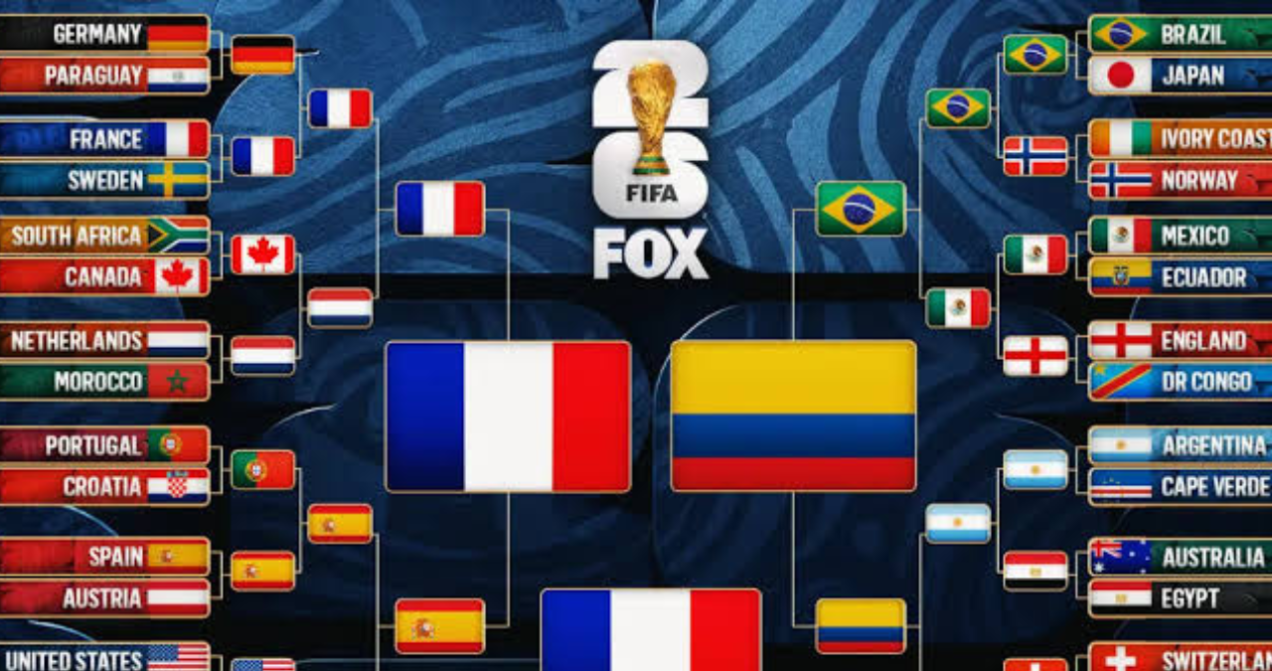
The official structure paired the winners of specific Round of 32 matches. For example, the winner of Match 74 met the winner of Match 77, while the winner of Match 73 met the winner of Match 75.
The Round of 16 pairings and results were:
- Paraguay 0–1 France
- Canada 0–3 Morocco
- Brazil 1–2 Norway
- Mexico 2–3 England
- Portugal 0–1 Spain
- USA 1–4 Belgium
- Argentina 3–2 Egypt
- Switzerland 0–0 Colombia, with Switzerland winning 4–3 on penalties
These results are recorded by FIFA in its official knockout-stage results.
This shows how a single Round of 32 result could determine an entire path toward the final.
Why the Round of 32 Is Important
The first knockout round is important for several reasons.
Every Match Becomes Do-or-Die
During the group stage, a team has multiple matches. In the knockout phase, one defeat ends the World Cup campaign.
That changes how teams approach the game.
A coach may be more careful with possession. A team may defend deeper. Players may avoid unnecessary risks, especially early in the match.
Extra Time Becomes Possible
If a knockout match is tied after 90 minutes, extra time can follow.
The 2026 Round of 32 included several matches that required extra time or penalties, including:
- Germany vs Paraguay
- Netherlands vs Morocco
- Belgium vs Senegal
- Argentina vs Cabo Verde
- Australia vs Egypt
FIFA’s official records show the relevant penalty shootouts and extra-time results.
Every Goal Can Change the Path
A goal doesn’t simply change the score. It can change the entire bracket.
For example, when a team advances, that winner moves into a predetermined Round of 16 position. From there, its result affects the quarter-final bracket and potentially the semi-final path.
That’s why fans often keep a bracket beside them while watching the tournament.
Understanding the Bracket Without Getting Confused
At first glance, the round of 32 world cup bracket can look complicated because of the 12-group system.
The easiest way to understand it is to follow the knockout matches one step at a time.
Think of the bracket as a tree:
32 teams
↓
16 Round of 32 winners
↓
8 Round of 16 winners
↓
4 quarter-final winners
↓
2 semi-final winners
↓
1 World Cup champion
Once you understand that basic structure, the rest becomes much easier.
The key point is that the bracket is not based only on traditional first-place versus second-place pairings. The 2026 format also included eight third-place qualifiers, and FIFA’s published match schedule specified the possible group combinations for those positions.
Round of 32 Match Locations
The expanded World Cup was hosted across Canada, Mexico, and the United States.
Round of 32 matches were held in several host cities, including:
- Los Angeles
- Boston
- Monterrey
- Houston
- New York/New Jersey
- Dallas
- Mexico City
- Atlanta
- San Francisco Bay Area
- Seattle
- Toronto
- Vancouver
- Miami
- Kansas City
FIFA’s schedule shows the locations and match numbers for the Round of 32.
This wide geographic spread was one of the defining features of the 2026 World Cup. Supporters followed their teams across three countries, while the tournament used 16 host cities overall.
The Difference Between the Round of 32 and Round of 16
The names can be confusing, especially for people who are more familiar with older World Cup formats.
The difference is simple:
Round of 32: 32 teams compete in 16 matches.
Round of 16: 16 teams compete in eight matches.
The Round of 32 was introduced as part of the expanded 48-team World Cup format. Before 2026, the World Cup normally moved from a 32-team group-stage field directly into a 16-team knockout stage.
The 2026 tournament therefore added an entirely new elimination round.
How the Bracket Helps Fans Follow the Tournament
A bracket isn’t only useful for statistics experts. It’s a simple way for casual fans to understand the competition.
A good bracket can help you:
- See which teams have been eliminated.
- Track every Round of 32 winner.
- Follow Round of 16 pairings.
- Understand possible quarter-final matchups.
- Follow a team’s route toward the final.
- Record scores and penalty shootouts.
- Compare different sections of the knockout stage.
It also makes discussions easier. Instead of saying that two teams might meet later, fans can look at the bracket and see whether their paths actually cross.
What Made the 2026 Bracket Different?
The biggest difference was the number of participating teams.
The 2026 World Cup had 48 teams rather than 32. FIFA’s approved format used 12 groups of four, and 32 teams advanced to the first knockout round.
The tournament therefore contained:
- 48 participating teams
- 12 groups
- 32 Round of 32 teams
- 16 Round of 32 matches
- 16 Round of 16 teams
- 8 quarter-final teams
- 4 semi-final teams
- 2 finalists
- 1 champion
The complete tournament consisted of 104 matches.
For football fans, that meant more matches, more teams, and a new stage to follow.
What Happens After the Round of 32?
After the Round of 32, the tournament becomes progressively smaller.
The Round of 16 reduces the field from 16 teams to eight. The quarter-finals then reduce eight to four. The semi-finals determine the two finalists.
In 2026, the quarter-final winners were France, Spain, England, and Argentina. Spain eventually defeated France in the semi-final, while Argentina defeated England in the other semi-final.
Spain then defeated Argentina 1–0 after extra time in the final on July 19, 2026, at New York New Jersey Stadium. FIFA recorded Spain as the 2026 World Cup champion.
This final result also demonstrates the full journey through the new format: teams reaching the final had to navigate the group stage and then four knockout rounds.
Tips for Reading a World Cup Bracket
If you’re looking at a World Cup bracket for the first time, don’t worry—it can seem like a maze at first.
Here are some simple tips:
Start With the Match Numbers
FIFA assigned match numbers to the knockout games. The Round of 32 began with Match 73 and finished with Match 88.
Follow Winners, Not Group Names
Once the group stage is complete, the easiest approach is to follow the winner of each match.
For example:
Match 73 winner → Match 90
Match 74 winner → Match 89
This makes it easier to see how one victory leads to the next stage.
Mark Extra-Time Results Clearly
A 2–1 result after extra time is different from a 2–1 result inside 90 minutes, even though the final score looks similar.
Likewise, a draw followed by a penalty shootout should be recorded separately.
Keep Penalty Shootouts Separate
In official football records, a penalty shootout does not change the match’s 90-minute score in the same way as an extra-time goal. The winner is determined by the shootout.
That’s why results such as Germany 1–1 Paraguay, Paraguay winning 4–3 on penalties, are useful when reading historical brackets.
Frequently Asked Questions About the round of 32 world cup bracket
What is the round of 32 world cup bracket?
The round of 32 world cup bracket is the first knockout-stage bracket used at the 2026 FIFA World Cup. It contained 32 teams playing in 16 matches, with the winners moving into the Round of 16.
Why did the World Cup have a Round of 32 in 2026?
The Round of 32 was added because the World Cup expanded from 32 teams to 48 teams. FIFA chose a format with 12 groups of four, allowing 32 teams to qualify for the knockout phase.
How many teams played in the Round of 32?
There were 32 teams, divided into 16 knockout matches.
How did teams qualify?
The top two teams from each of the 12 groups qualified automatically. Eight additional teams qualified as the best third-place teams.
Can a third-place team reach the Round of 32?
Yes. The 2026 format specifically allowed eight of the best third-place teams to advance.
What happened if a Round of 32 match was tied?
A tied knockout match could go to extra time. If the teams were still level, the winner could be determined by a penalty shootout. Several Round of 32 matches in 2026 were decided this way.
How many Round of 32 matches were there?
There were 16 matches because 32 teams were competing and each match eliminated one team.
When was the 2026 Round of 32 played?
The Round of 32 took place from June 28 through July 3, 2026. FIFA’s official match schedule lists all 16 fixtures and results.
Was the Round of 32 used before 2026?
The Round of 32 as the World Cup’s first knockout stage was introduced with the 48-team tournament format in 2026. Previous editions with 32 teams began their knockout stage with 16 teams.
Final Thoughts on the round of 32 world cup bracket
The round of 32 world cup bracket marked a major change in the history of the FIFA World Cup. With 48 teams competing, the tournament needed an additional knockout round, creating a new stage filled with high-pressure matches, extra-time battles, and penalty shootouts.
The 2026 Round of 32 featured 16 matches across Canada, Mexico, and the United States. Canada, Paraguay, Morocco, Brazil, France, Norway, Mexico, England, USA, Belgium, Portugal, Spain, Switzerland, Argentina, Colombia, and Egypt all advanced from this stage. FIFA’s official records document the complete results and the route those teams took into the Round of 16.
More importantly, the new structure gave fans another exciting part of the tournament to follow. The group stage determined the starting positions, while the knockout bracket created a direct path toward the trophy. Once the first whistle of the Round of 32 sounded, every match carried enormous importance because defeat meant elimination.
For anyone researching the round of 32 world cup bracket, the key idea is simple: 32 teams entered, 16 matches were played, and 16 winners continued their journey. From there, the field was reduced round by round until Spain lifted the 2026 FIFA World Cup trophy after defeating Argentina in the final.
The new round of 32 world cup bracket has therefore become an important part of understanding how the expanded FIFA World Cup works and how teams can move from the group stage all the way to football’s biggest prize.